Journal of Educational Controversy

OUR YOUTUBE VIDEOS FROM JECWWU CHANNEL -- 49 videos

Wednesday, March 28, 2012

Will Arizona Go After Ethnic Studies Programs at Universities Next?

“Arizona Official Considers Targeting Mexican American Studies in University”

This is the latest news headline coming out of Arizona. See http://latino.foxnews.com/latino/politics/2012/03/28/arizona-official-considers-targeting-mexican-american-studies-in-university/

The article reports that:


Arizona’s superintendent of schools, John Huppenthal, says Tucson’s suspended Mexican American studies curricula teaches students to resent Anglos, and that the university program that educated the public school teachers is to blame. “I think that’s where this toxic thing starts from, the universities,” Arizona Superintendent of Schools John Huppenthal said in an interview with Fox News Latino.”
We will continue to follow events as they unfold.

Monday, March 19, 2012

Should we be Emulating the Tucson Mexican American Studies Program rather than Eliminating It?

Editor: rather than eliminating the Mexican American Studies Program in the Tucson Unified School District in Arizona, author Keith Catone argues in the post below that we should be emulating it.  We thank the author and the Annenberg Institute for School Reform at Brown University for permitting us to reprint the article.


Emulate, Don't Eliminate, Tucson's Mexican American Studies Program

by Keith Catone

Published on March 16, 2012


An ethnic studies program that was banned by a controversial Arizona state law should be reinstated and championed as a national model of best practice.

The documentary film Precious Knowledge compellingly captures the ways in which Tucson Unified School District’s (TUSD) Mexican American Studies (MAS) program has transformed the educational experiences of many of its students. The program, a series of core academic classes taken by Tucson high school students, concentrates on Mexican American history and perspectives. The students featured in the film discuss the ways in which they were newly energized by what they experienced in MAS classrooms. They described how learning about their own history and in ways relevant to their own culture led them to be more engaged in school as a whole.

At the Annenberg Institute for School Reform, we currently support efforts to increase and deepen student-centered learning in classrooms across New England. Ensuring that learning is relevant and responsive to students’ identities and their communities is at the heart of student-centered learning. This is exactly what Tucson’s MAS program strives to do.

The data tell us that this approach appears to be working. Students in the MAS program far outperformed their peers on Arizona’s state standardized tests in reading (by 45 percentage points), writing (by 59 percentage points), and math (by 33 percentage points), and they enroll in post-secondary institutions at a rate of 67 percent, well above the national average (Ginwright & Cammarota 2011). Also, pedagogies used in Tucson’s MAS classes encourage and support students to be actively involved in their communities, a strategy that has been shown to correlate with increased classroom engagement (Cammarota & Romero 2009).

Despite these successes, in January 2011 State Attorney General Tom Horne declared that the MAS program was in violation of Arizona state law HB2281. As outlined by Shawn Ginwright and Julio Cammarota (2011) in AISR’s journal Voices in Urban Education, HB2281 – promoted by Mr. Horne and passed into law when he was state superintendent of schools in 2010 – was specifically crafted to target TUSD’s MAS program. The law makes illegal any courses that “(1) promote the overthrow of the U.S. government, (2) promote resentment toward a race or class of people, (3) are designed primarily for pupils of a particular ethnic group, and (4) advocate ethnic solidarity instead of treating pupils as individuals.” Teachers and students from the program have spent the past year challenging in federal court the constitutionality of HB2281 and the state’s ruling. But prior to any final court decision, on January 10, 2012, the TUSD school board voted to immediately cease MAS classes for fear of losing state education aid.

Critics of the MAS program have pointed to the use of texts like Paulo Freire’s Pedagogy of the Oppressed and Rodolfo Acuña’s Occupied America: A History of Chicanos as evidence that TUSD’s MAS program promoted radical ideas prohibited by HB2281. But these decontextualized critiques miss the fact that the classes aimed to fully embrace the historical realities and everyday experiences behind being Mexican American and utilized these qualities to develop a rich, rigorous, and engaging course of study that taught students to think critically about issues of politics, race, and identity. Rather than banning what appears to be a highly effective program, education officials and policymakers should instead concentrate their efforts on learning more about whether and how MAS might have contributed to such impressive student outcomes.

Ironically, though, the banning of Tucson’s MAS program has actually led to its widespread recognition and celebration. The controversy has generated interest from bloggers, organizations, and news outlets across the country. The American Educational Research Association passed resolutions condemning both HB2281 and the suspension of MAS classes, calling for the law’s repeal and the program’s reinstatement. Community and education activists have organized screenings of Precious Knowledge in cities across the country that have also served as fundraisers for the legal battle. Other activists have organized a four-day awareness-raising caravan carrying books that were part of the Tucson MAS curriculum and have since been banned. This week, they have traveled from Houston to Tucson, making stops along the way in San Antonio, Texas, and Albuquerque, New Mexico.

This effort, coined “Librotraficante” (or book-trafficker), has gained endorsements from iconic authors whose books have been removed from MAS classrooms in Tucson like Sandra Cisneros (House On Mango Street) and Rudolfo Anaya (Bless Me, Ultima), who will both speak at caravan stops. Finally, in an effort to ensure that the curriculum and pedagogy practiced by the program does not disappear, the national Network of Teacher Activist Groups (TAG) has developed a curriculum guide, No History is Illegal, for teaching about what’s happening in Arizona. Nearly 1,500 educators from across the globe have pledged to teach from the curriculum guide, which includes sample lessons and materials borrowed directly from some of Tucson’s MAS teachers, plus more teaching ideas and resources developed by teachers from across the country.

What these responses make clear is that the teaching and learning practiced through Tucson’s MAS not only has the support of many, but also has the power to engage learners from all walks of life. The curriculum offers the kind of student-centered approach that we need more of in classrooms throughout the United States. If the injustices in Arizona are not rectified, then hopefully the current attention being given to Tucson’s MAS program will, at the very least, help others consider how similar programs might benefit students in their own schools and communities.

________________________________________

PREPARED BY

Keith Catone
Senior Research Associate, Community Organizing and Engagement
Annenberg Institute for School Reform
Keith_Catone@brown.edu
________________________________________

REFERENCES

Cammarota, J., and A. F. Romero. 2009. “The Social Justice Education Project: A Critically Compassionate Intellectualism for Chicana/o Students.” In Handbook of Social Justice in Education, edited by W. Ayers, T. Quinn, and D. Stovall, pp. 465–476. New York: Routledge.

Ginwright, S., and J. Cammarota. 2011. “Youth Organizing in the Wild West: Mobilizing for Educational Justice in Arizona!” Voices in Urban Education 30, pp. 13–21.

Sleeter, Christine. 2012. "Ethnic Studies and the Struggle in Tuscon" Education Week.


This post originally appeared in "AISR Speaks Out: Commentary on Urban Education" on March 16, 2012, and is reprinted with permission from the Annenberg Institute for School Reform at Brown University.  Go to:  http://annenberginstitute.org/commentary/2012/03/emulate-dont-eliminate-tucsons-mexican-american-studies-program


Tuesday, March 13, 2012

What Lessons did the Arizona Legislature Teach the Students when They Banned Mexican American Studies: Teacher Curtis Acosta Shares a Student’s Letter

Editor: In an earlier post, I reflected on the lessons that might have been learned by the students whose books were banned from the classroom by the Arizona State Legislature.  “For young people whose encounter with these books led to self discovery, positive images of Latino identity, and transformative knowledge and action, the State’s actions must surely have been traumatizing and a lesson in the very oppression and hegemony that often defined the social conditions of their communities.”  In the post below, teacher Curtis Acosta shares a letter from one of his students that reveals something even deeper that was experienced by his students as a result of the collective support that has been generated across the nation in response to the legislature’s actions.  I want to thank Mr. Acosta for permitting us to share his letter with our readers.
Letter from Teacher Curtis Acosta
Tucson Unified School District, Arizona

March 8, 2012

To the nation and network of love and support,
From all of the students and teachers of Mexican American Studies and Save Ethnic Studies in Tucson, Arizona, we are humbled and moved by the Teacher Activist Groups, the Education for Liberation Network, and each one of you that participated in "No History Is Illegal." It is difficult to fully express how important your words, actions, and hard work have meant to us. As I sit in my classroom each day I am faced with an overwhelming feeling of loss. Regardless of the resiliency of our students and my own resolve not to let the dismantling of our curriculum, classes and pedagogy alter my own commitment to serving the youth of my community, it is impossible not to be affected. That is why all your testimonies and actions have been so important. Each time we have a fleeting moment of defeat, we are able to be embraced by your words and stories from the "No History Is Illegal" campaign. Stories from Rhode Island, Colorado, Minnesota, California, and Oregon amongst many others have brought smiles, pride, and even tears of joy to my students and fellow colleagues.

When I asked my students to contribute to this email, one of our student leaders, Nico Dominguez, wanted to express his appreciation and his words follow:

After all that has happened in regards to the loss of Mexican American Studies, there are many moments in time that are able to lift my spirits back up. I will definitely say that seeing/experiencing out of Tucson, support for our movement (classes) is a great way of lifting up my spirit. I remember the first time I experienced out of Tucson support for our classes. Seeing different people speak and perform passionately about our classes was a great experience the day of the teach-in at the Casino Ballroom on January 24th. I had not experienced any of that previous to the teach-in. It was definitely an experience that I will carry with myself from here on.


Since that day, there has been a massive amount of support which is overwhelming. Students from all over the country have done something for M.A.S., including Oakland, Chicago, Northridge, New York, and on. All of these experiences I take to my heart. The feelings that I get when I remember all of these people who have in some way involved us into their lives is overwhelming and just a true sign of the humanity that exists. As these experiences continue, I am reminded of the vastness of the world that I live in and that I must learn to live in harmony with it.


--Nicolas Dominguez
Nico's words help me stay strong and remind me why we continue to fight for our students' rights to study their own history, literature and culture and we will never give up!

In that spirit, I would ask you all to send more love our way as our lawsuit moves forward to repeal this hateful law. There are big court dates ahead and you can stay apprised of the latest news through Save Ethnic Studies where you can also donate to our legal effort.


Next week the Librotraficante Caravan will depart from Houston for Tucson with "Banned Books" to be distributed in San Antonio, Albuquerque and Tucson. Chicano writers and supporters will be hosting workshops, performances, and readings. Please checkout their website for more details.

In the next few weeks I will have a major announcement about a television appearance about our issue, but I'm still sworn to secrecy. Stay tuned for that one.

Lastly, a 50 minute version of Precious Knowledge will be shown on the national PBS show Independent Lens on May 17th. We are hoping to coordinate a national event for that night so I will write more as those details become clearer.


Again, thank you to everyone and we are hopeful of better news and better days ahead. You all have helped our optimism and belief that justice will prevail.

In Lak Ech,

Curtis Acosta


Editor: The film, ”Precious Knowledge,” that Mr. Acosta refers to above will be shown at Western Washington University sometime in April.   We will announce the date and time later.

Sunday, March 11, 2012

Diane Ravitch's Report Card Flunks Secretary of Education Arne Duncan

In an article in the March 7th issue of The New York Review of Books, Diane Ravitch critiques Arne Duncan’s performance as our Secretary of Education. See “Flunking Arne Duncan.” Her grades on his report card in six categories are:

Report Card: Arne Duncan


Fidelity to the Constitution                 F


Doing what’s right for children             F


Doing what’s right for public education F


Respecting the limits of federalism      F


Doing what’s right for teachers            F


Doing what’s right for education          F
But the greatest tragedy of our times, writes Ravitch, is that "it is hard to find any leader of either party who stands forthrightly today as a champion of students, teachers, public schools, and good education."


Reflecting on our times, she writes:
We will someday view this era as one in which the nation turned its back on its public schools, its children, and its educators. We will wonder why so many journalists and policymakers rejected the nation’s obligation to support public education as a social responsibility and accepted the unrealistic, unsustainable promises of entrepreneurs and billionaires. And we will, with sorrow and regret, think of this as an era when an obsession with testing and data obliterated any concept or definition of good education. Some perhaps may recall this as a time when the nation forgot that education has a greater purpose than preparing our children to compete in the global economy.
For a review of Diane Ravitch's recent book, The Death and Life of the Great American School System: How Testing and Choice are Undermining Education, read Chris Ohana's review in our current issue of the Journal of Educational Controversy.

Saturday, March 3, 2012

WHO BREAKS A BUTTERFLY UPON A WHEEL


Our friends over at Publicola have recently been hosting a rousing debate between big bucks Democrat Nick Hanauer and WEA President Mary Lindquist on teachers’ unions and K-12 schools. Here at the blog, we have a hard time resisting sticking our nose into issues we don’t know much about, so we decided to join the fun with our own open letter to Mr. Hanauer:
Dear Mr. Hanauer,
I’ve been reading your recent Publicola colloquy with WEA President Mary Lindquist with interest. I appreciate the way that you have genuinely engaged the question of what you call school reform and that you took the time to respond to Mary’s letter to you. That’s unusual—most rich people who appoint themselves experts in something don’t usually engage with the people they criticize. You seem like a guy who might be willing to listen, so I’d like to take the presumptuous step of joining the discussion.
In the full disclosure department, I am a professor at Western Washington University and the president of the United Faculty of Washington State, which represents the faculty at Washington’s four regional comprehensive universities. We are affiliated with WEA and I sit on the WEA Board of Directors. But, while I have learned a lot about K-12 education from the teachers and staff at the WEA, my union work deals almost exclusively with higher education, so I’m probably as much out of my depth as you are when it comes to K-12 education. This letter is from one uninformed outsider to another and is not in any way an official response from the WEA.
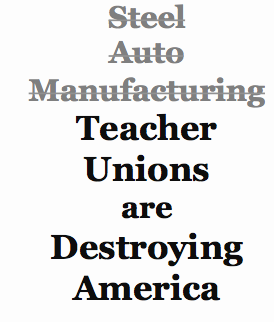
In your letter to Mary you say that it’s not the hard-working, dedicated teachers who are ruining education but rather their nasty, child-hating union. I grew up as an upper middle class white boy in the American South, where all of the white grownups had their favorite Black people—the cook, the person who looked after the kids, the guy who took care of the cattle for a share of the corn crop. But God forbid that one of those favorites be seen gathering on a street corner with Black people from out of town, or at an NAACP meeting, or having coffee with a union representative. At the first hint of any organized activity, our grownups would turn on their favorite Black people faster than a summer squall could dump an inch of rain on the pasture. Suddenly the individuals who had been so tender, wise, and trustworthy were scary, too stupid to know better, and not to be let into the house. Everybody loved the solitary black person, nobody liked it when they started to bunch up and talk crazy.
That’s kind of the way it is with teachers. Everybody loves a teacher, nobody likes the big, bad teachers’ union. As long as they’re staying after school to give the extra help to the kids who need it or reaching into their own pockets to pay for the supplies that the state doesn’t anymore, teachers are saints. But when they collectively advocate for decent wages, adequate health care, and working conditions that don’t erode by the minute they’re a threat to the moral fabric of the state.
Perhaps it is this construction of a teachers’ union that isn’t composed of teachers (the same way my southern relatives always believed that organized black people were put up to it by uppity Northern Blacks or communists) that leads to some of the difficult constructions in your letter to Mary. You say that “the vast majority of Washington’s teachers care deeply about student outcomes, work incredibly hard, and are constantly working to improve their instructional practices.” But in the very next paragraph you talk about the “elements that are largely missing from our State’s public education system: relentlessly high standards, a culture of excellence, and a systemic commitment to innovation.” For both of these things to be true, you have to imagine the deeply caring, hard working, forward looking teachers you describe coming together in their democratically elected union and suddenly losing all interest in excellence and innovation.
The truth is that teachers in this state and across the country are concerned about the “reforms” so relentlessly pursued by well-funded corporate interests (from Arne Duncan to the Gates Foundation to the League of Education Voters) because many of them will do to public education what the same kind of privatizing “reform” did to health care. Education is what Wall Street has called “the big enchilada,” the last big public sphere (after health care) available for private exploitation and profit. And if we privatize education while trotting out euphemisms like reform, efficiency, and excellence, we’ll get exactly what we have now with health care. Rich people will have access to the best education in the world and everybody else will get education that is extremely profitable but below the standards of many developing countries.
There is something deeply disingenuous about the arguments that you and other business elite school reformers make when you say things like “I am not a teacher and would not presume to tell you how to teach . . . but in my experience as a business leader and entrepreneur . . . .” The education foundations and leagues and task forces that people like you fund are full of non-teachers who are constantly telling teachers how to teach, but even if that weren’t true, the evidence of your steel-eyed business sense is hard to see in the education “reforms” you’re pushing. I’m not a business leader and entrepreneur, but it isn’t a stretch to imagine that if education were a company you were trying to turn around, you wouldn’t be focusing on the stuff that’s always a part of education “reform.”
  • If you had a company that was as desperately underfunded as public education, you probably would make that funding your first priority.
  • If you had a company that needed more workers as desperately as public education needs more teachers, you wouldn’t spend all your time worrying about the order in which you were going to lay off the workers you have.
  • If you had a company that desperately needed the most trained and qualified workers the way that our schools need the most trained and qualified teachers, you wouldn’t turn to a temp agency like Teach For America (whose freshly scrubbed and earnest young charges make up for their lack of qualification with lots of well-meaning white liberal racism).
  • And you certainly wouldn’t spend your time writing complicated and lugubrious evaluation policies that only the most committed HR bureaucrat could love.
If a smart business person like you were running public education and looking to genuinely succeed, you would hire the very best people you could find, you would hire enough of them, you would pay them very well, you would get out of their way and let them do their jobs, and you would fire them if they didn’t get that job done. The only thing that the education “reform” movement seems to be genuinely interested in is the firing part.
In your letter to Mary, you tell the world that “my record as a proponent of more funding for our public schools is unassailable.” Bully for you. The fact that you and everybody else has failed in the quest for adequate funding (as even the State Supreme Court has acknowledged) should not lead you to abandon your progressive values.
You shouldn’t fall into the trap of scapegoating teachers for American racism and class inequality. A UW Philosophy grad like yourself should know that a teacher evaluation bill isn’t going to make a dent in the alloy of democracy for white men, capitalism, and racialized slavery that coalesced in the 18th century and created the backbone of American inequality that persists to this day
You should get out of the weeds of charter school statistics and Bellevue anecdotes and recognize that the assault on teachers’ unions has nothing to do with education and everything to do with the further erosion of public infrastructure and what few collective bargaining rights remain. Most school reform policies come from a very unprogressive playbook and most of the bills you support get their templates from ALEC.
You should recognize that public school in the United States has never been pure. The two big forces behind creating and mandating public schooling have been anti-Catholicism and child labor laws. Nineteenth-century Protestant elites, fearing that Catholic schools were creating a populace more loyal to the Pope than the President, were the driving force behind the public school system. And in the twentieth century, mandatory public schooling to the age of 16 went hand in hand with the outlawing of child labor and the need to create a warehouse for the suddenly unemployed and unruly mob of children of the laboring classes. School is as much about learning to pledge allegiance, line up, and respond to Pavlovian bells as it is about education. Teachers work in a context that is usually completely antithetical to the creativity and innovation you talk so much about. Insofar as you’re interested in public schools as something more than a factory that produces semi-skilled workers for businesses, you should focus on reforms more fundamental than busting teachers’ unions.
Maybe you should have tried to have a cup of coffee with Mary Lindquist before you made a big public show of chatting up Rob McKenna—another guy who, like you and me, doesn’t really know anything about K-12 teaching.
The WEA has its problems—it’s almost as white as you and me and it has all the usual inefficiencies that come with a big democratic organization. But the WEA is not education’s problem.
I hope you’ll consider that.
Sincerely,
Bill Lyne
Who tried teaching high school for one year before moving on to the much less difficult job of college professor.

Friday, March 2, 2012

JEC Associate Editor, John Richardson, Receives Award for “Comparing Special Education: Origins to Contemporary Paradoxes”

John Richardson, Associate Editor of the Journal of Educational Controversy and Professor Emeritus of Sociology at Western Washington University, has received the “Outstanding Book Award” for contemporary issues in curriculum by Division B of the American Educational Research Association (AERA) for his recent book, Comparing Special Education: Origins to Contemporary Paradoxes. The book is coauthored with Justin J.W. Powell . We reviewed Professor Richardson’s book in our current issue. Read Ellen Brantlinger’s review here.


Congratulations John!

Saturday, February 25, 2012

A Courageous Young Student Fights for his Rights in Court and Wins: Russell Dickerson III Talks to Teachers on What They Need to Know about Bullying

Editor: After enduring years of bullying and harassment during his junior high school and high school years, Russell Dickerson decided to file a lawsuit against the Aberdeen School District in Washington State on the grounds that the “deliberate indifference to ongoing harassment by the school district, which receives federal funds, violated federal law – Title VI of the Civil Rights Act of 1964 and Title IX of the Education Amendments of 1972. The district’s negligent inaction also violated the Washington Law against Discrimination.” In our post below, “Washington State ACLU Achieves Settlement for Bullying Victim,” we announced a settlement achieved by the ACLU for $100,000 from the district with an additional $35,000 in legal fees to the ACLU. In its announcement (see below), the ACLU draws a picture of the kind of harassment and bullying that young Dickerson underwent. Dickerson, now 20, explained why he took the action he did. “I learned from my parents that you should never give up. You should fight for your rights – you don’t just walk away,” said Dickerson.


We asked Russell if he would write a personal letter to teachers and prospective teachers on what they need to know about bullying and harassment and what they can do. We hope that his thoughts will be the impetus for the beginning of a serious conversation by educators.


Russell Dickerson’s Open Letter to Teachers on What They Need to Know about Bullying and Harassment

By Russell Dickerson III

In today's classrooms, it's hard not to have disruptions in the educational process. With students of different needs, backgrounds and intellect, teaching (and learning) can be hard with disruptions. There might be an unruly child or two with a hyperactive disorder who acts out during a lesson. You might have experienced (or will experience for those who are student teachers) students' heads pointing downwards toward their lap, texting on their phone during a lesson. Sometimes, you'll have parents who advocate their child—not the teachers or the school system—for better or worse, kind of like “the customer is always right” doctrine. These are quite common distractions. Worse yet, bullying can eclipse these relatively small distractions in the educational process.


What effect does bullying have on victims in relation to their learning process? Students who are bullied will find it really difficult and often treacherous to take in the lessons they need to learn. Why? Quite often, when you've just been bullied, you are no longer focusing on what you should be focusing on. You get worried, or you might be sad, mad, scared or upset. Maybe you might be ashamed. Thus, your self-esteem will collapse, and adding fractions will feel so much more difficult, if not impossible. Let's take a look at a different perspective: Nobody likes to be in a place that they attribute negatively. Repeated bullying can make victims feel unwelcome and isolated. Victims of bullying will dread going to school and may frequently become absent. Everybody knows that chronic absences, no matter the circumstance, are detrimental to the educational process.


What about the bullies, and why do they do what they do? Bullies almost always look for “faults” – i.e. what is unique about a person, but gets erroneously interpreted into a defect. The bully usually feels low self-esteem, and feels that they must enhance it, albeit in a negative way. Sometimes, bullies are actually victims of bullying as well. There's also the fact that some students may come from abusive or abrasive families and continue their behavior at school because they think their behavior is acceptable.


What can be done about bullying? I always get asked that question, and unfortunately, there are no right or wrong answers, and it's utopia to think that bullying can be eliminated. I am not an expert on behavior, and it all depends on the kind of culture the school has, and even then, you will be dealing with different kinds of students who come from different cultures, beliefs, values and other factors.


There are good preventative measures that educators can take, though, such as:


• Taking on a “zero-tolerance” stance. No matter what, no matter who, don't tolerate bully behavior. Stay firm with consequences. Stay consistent. When you speak with a student who bullies, try some strategies to help him or her reconsider their actions. For example, ask, “How would you feel if the tables were turned and this happened to you?” Almost always, they'll rethink their behavior.


• Maintaining vigilance. Watch for behavior changes. Has a student who has participated very well in class discussions suddenly become quiet, or a student who normally does stellar work now starts to struggle? While there may be other circumstances (and it's equally important to see the root of the problem for problems not relating to bullying), there's a chance that student may be bullied and harassed. Vigilance doesn't stop there—watch for bullies as well. Even something as subtle as saying something mildly negative (such as “Your shirt looks funny”) may grow and fester to more aggressive behavior. Watch and act accordingly.


• Speaking up. You all know it's necessary to report serious or constant harassment issues to administration, right? Not only do you tell the heads of the school, the parents of the bully need to know. There's always the assumption that the bully's parents are already aware and won't do anything to correct their child's behavior, but that isn't always true. Unfortunately, there are parents who are indifferent, and although rare, actually find no fault in bully behavior. Be candid. Openly admit that their child has a problem. Offer to be an ally and help to come to a resolution that everyone can agree on.


• Being a condolence. While not a preventative measure, it always helps to make yourself available to a student who happens to be a victim of bullying. Never “showcase” your attention to other students, such as in front of the class, as that can cause more problems. Perhaps ask to see the student during recess or whenever, and reassure the student that you won't allow it to happen. It can be even more reassuring when you mention that you might bring up an anecdote of when you were in a similar situation, so the student doesn't feel alone.
There are certain issues that will never go away, and student bullying happens to be one of them. On the positive side, it can be less of a problem if you are firm, take no tolerance, vigilant and aware.

Friday, February 17, 2012

The Contraception Controversy Again Raises the Separation of Church and State Question

Today’s news coverage over an individual’s religious liberty rights and the right of equal protection to a social benefit in a democratic community, i.e., preventive health care, once again raises the question over where the line should be drawn between church and state. In our current issue of the Journal of Educational Controversy, author John F. Covaleskie brings some deeper analysis to this larger question in his article, “Public Speech and Religion in the Public Square: Creating Citizens who can Breach the Wall.”


In the article, the author first analyzes and compares responses to the question by three different public figures -- John F. Kennedy, Mario Cuomo, and Mitt Romney -- each a member of a religious faith, and each trying to define his role as a public servant serving many faiths in our pluralistic society. Covaleskie then asks the reader to consider the many politically divisive issues in the public debate today and what the role of individual conscience should be in the formation of public policy.


Because the schools create a public for democratic life, Covaleskie is particularly concerned about the level of public discourse in the media today and what that teaches the young about democratic discourse where those who “differ with us are the enemies and must be destroyed.” How do we create democratic citizens who are able to negotiate their differences and take into account the life perspectives of their fellow citizens as they search for common ground? To read the author’s answer to this crucial question, read his article, “Public Speech and Religion in the Public Square: Creating Citizens who can Breach the Wall.”

Monday, February 6, 2012

Grace Lee Boggs Responds to our Review of her Book, The Next American Revolution

Our current issue of the Journal of Educational Controversy published two reviews of The Next American Revolution: Sustainable Activism for the Twenty-First Century by Grace Lee Boggs with Scott Kurashige.  Actually, one is a traditional book review and the other is a personal open letter to Grace Lee Boggs for the influence the book has had on the life of this reviewer.  The reviewers will be responding to each other later on this blog. We are pleased to print Grace's response as part of our effort to engage our readers in an ongoing conversation.

Grace Lee Boggs Responds to her Reviewers from the Journal of Educational Controversy
with Scott Kurashige

It has been a true joy to see so many diverse peoples turn to this little book for help in understanding how and why another world is necessary, possible, and already in the process of being created. The thoughtful responses by Molly and Victor reveal the huge reserves of humanity that have been repressed by our "civilization" and are being unleashed by the movements of 2011 to heal us.

Their book reviews further help us to understand that people are finding inspiration from the book because they are connecting with a set of ideas whose time has come:


• Maybe it’s because it is giving Americans in all walks of life a more people-friendly view of revolution as empowerment rather than struggle for political power.


• Maybe it helps us view Revolutionaries as Solutionaries, working together to solve very practical problems of daily life, growing our souls by growing our own food.


• Maybe it’s giving us the new, more positive view of ourselves that we’ve been hungry for.


• Maybe it helps us envision ourselves as Revolutionaries, moving away from the wrong side of the world revolution where we have seemed stuck since the Vietnam War.


• Maybe it also helps us see ourselves as Evolutionaries, making the radical revolution of values that Dr. King called for during that war, transformimg ourselves from materialists, militarists, and individualists into a people who can be proud of how we are advancing humankind to a new stage of consciousness, creativity, and social and political responsibility.

To link to the book reviews, go to:

1. A Book Review by Victor Nolet

2. A Personal Open Letter to Grace Lee Boggs by Molly Lawrence

Saturday, February 4, 2012

NO HISTORY IS ILLEGAL-- A Grassroots Campaign Challenges Arizona's Ban on Mexican American Studies


We announced in our last post that our current issue of the journal has an article by Augustine Romero, Director of Student Equity and Co-Founder of the Social Justice Project of the Tucson Unified School District in Arizona, in which he describes the political climate that led to the legislation banning the Mexican American Studies Program in Tucson, Arizona. See “The Hypocrisy of Racism: Arizona's Movement towards State-Sanctioned Apartheid. “ Our blog has been continuing to cover this story with updated news.

We have learned of a national grassroots movement that is rising up to challenge this ban to eliminate certain voices and stories from the curriculum. A Network of Teacher Activist Groups (TAG) is coordinating a month of solidarity activities in support of the Tucson’s Mexican American Studies (MAS) Program. Across the nation, the reading of the banned books, teach ins, and discussions are taking place in classrooms, community centers, houses of worship, and homes. On February 1st, the first day the Tucson schools had to comply with the law, students here on our own campus engaged in an all-day open dialogue with critical inquiry sessions about ethnic studies, culturally relevant curriculum, and the Arizona Ethnic Studies Ban.

The Network of Teacher Activists Groups has set up a website , “No History is Illegal: A Campaign to Save our Stories,” where readers can find a guide that includes sample lesson plans from the Mexican American Studies curriculum as well as creative ideas and resources for exploring this issue with students.


Check out the website, “No History is Illegal: A Campaign to Save Our Stories

Wednesday, February 1, 2012

Fifth Anniversary Issue of the Journal of Educational Controversy Now Online: The Education and Schools our Children Deserve

We are pleased to announce the publication of our special issue of the Journal of Educational Controversy on the theme, “The Education and Schools our Children Deserve,” co-edited with Susan Donnelly, head of the Whatcom Day Academy. This issue of the journal will also introduce to our readers the new dean of the Woodring College of Education at Western Washington University --- the home of the journal. Dean Francisco Rios brings with him a vision of the public mission of schools in a democratic society and the kinds of teachers that can make that education possible. He shares that vision with us in his first published article for our journal, “The Future of Colleges of Education.”


As I mention in my editorial to the issue, it is fitting that an anniversary issue should touch on one of the most fundamental questions in education – the education and schools our children deserve, as well as engage those ideas in an experimental, innovative format. Readers will see some unique use of multi-media in this issue. For example, in addition to our usual printed book reviews, we have developed our first video review. Two college professors and a school teacher were filmed in our studio engaging in a conversation around Paul Shaker’s book, Reclaiming Education for Democracy: Thinking Beyond No Child Left Behind. The author then responded to the video review of his book in a printed article following the video. Likewise, we are trying an experiment to see if we can extend the conversation started in the journal on the blog. Two reviewers were selected to review Grace Lee Boggs book, The Next American Revolution: Sustainable Activism for the Twenty-First Century. The author, Grace Lee Boggs and the co-author, Scott Kurashige, will also join in on the conversation. We will be posting the response by Grace Lee Boggs shortly on this blog.


And finally, our entire third section gives the reader a look inside a model school with video interspersed throughout the article. The school, the Whatcom Day Academy, is our partner school in the National League of Democratic Schools. Our partnership has enabled us to engage with actual practices and to share them with our readers.


We extend an invitation to our readership to engage the authors and the reviewers on our blog in a continuing, seamless conversation. It again exemplifies our attempt to generate an ongoing dialogue in the journal with scholars, practitioners and the general public.


We are dedicating this issue to Alfie Kohn, whose book, The Schools our Children Deserve, was the inspiration for this issue. In his prologue to this issue, Mr. Kohn reflects on the years since the publication of The Schools our Children Deserve and the need more than ever to be asking what kind of schools our children still deserve.


The issue is divided into three sections.


Section one is a series of articles that were written in response to the controversial scenario posed for the issue. Authors come at it from different perspectives and with different disciplinary tools, but together they form a vital chorus of important voices that look at “the education and schools our children deserve” from outside the dominant discourse that frames today’s political debates.


Section two is an “In the News” section. Here we took a very controversial issue in the news, namely, the Arizona legislation to ban ethnic studies in the schools. Under a copy of the legislation that our readers can read in its entirety, we published an article from the director of the school district that was under attack. Augustine Romero tells his own story about the events that took place in Arizona’s Tucson Unified School District.

Section three is our attempt to give readers an idea of what a “school meant for children” would look like. This section embeds some twenty-three videos of actual school classrooms in an article written by Susan Donnelly, the head of the Whatcom Day Academy. The Educational Institute for Democratic Renewal, which houses the Journal of Educational Controversy, has partnered with the Whatcom Day Academy as part of a network of schools started by John Goodlad called the National League of Democratic Schools.


We believe that the current political dialogue on education omits a discussion of the deepest questions we should be addressing. This issue was an attempt to address those questions.


Here is the controversy that was posed to the authors:


The politicizing of education at the national level has centered on issues of standards, accountability, global competitiveness, national economic growth, low student achievement on worldwide norms, and federally mandated uniformity. There has been little discussion of the public purposes of our schools or what kind of education is necessary for an individual’s development and search for a meaningful life. There is a paucity of ideas being discussed at the national level around topics such as: how school practices can be aligned with democratic principles of equity and justice; how school practices can promote the flourishing of individual development as well as academic achievement; what skills and understandings are needed for citizens to play a transformative role in their society. Without conversation at this deeper level about the fundamental purposes of education, we cannot develop a comprehensive vision of the kinds of schools our children deserve. We invite authors to contribute their conceptions of the kind of education our children deserve and/or the kinds of schools that serve the needs of individuals and of a democratic society.
We invite our readers to enjoy reading the issue and join in the conversation.

Thursday, January 26, 2012

Washington State ACLU Achieves Settlement for Bullying Victim

The ACLU of Washington State announced today a settlement for a former student who had been bullied throughout his junior high and high school years. Below is the ACLU's official announcement.  Our blog has been following this serious problem in this state and across the nation.

January 26, 2012

Contact: Doug Honig, ACLU-WA

206-624-2184

Former Student Gains Major Settlement after Enduring Years of Harassment

A former student who endured severe and persistent harassment throughout junior high and high school has gained a major settlement from the Aberdeen School District, the ACLU of Washington announced today. The ACLU has represented Russell Dickerson III in a lawsuit saying that school district officials were aware of the harassment but failed to take steps reasonably calculated to end it. Under terms of the settlement, Dickerson will receive $100,000 from the district. Additionally, the ACLU will receive $35,000 in legal fees.


“Public school officials must be held accountable when they fail to meet their responsibility to act decisively when a student is subjected to harassment by his peers. This settlement sends a message to school districts statewide to take strong action as soon as they learn that a student is being bullied,” said Sarah Dunne, ACLU-WA legal director.


“I learned from my parents that you should never give up. You should fight for your rights – you don’t just walk away,” said Dickerson.


Russell Dickerson III, now 20, is an African-American resident of Aberdeen. For six years, from 2003 when he entered junior high until 2009 when he graduated high school, other students harassed Dickerson on the basis of his race, sex, and perceived sexual orientation.

At Miller Junior High, Dickerson was called names by other students and found notes in his backpack and taped to his back calling him “stupid nigger” and “dog.” Students tripped him in the hallways and threw food at him in the cafeteria. In one incident, three students pushed him to the floor in the hallway and smashed a raw egg on his head; only one of the students was disciplined.


At Aberdeen High School, the harassment escalated, with Dickerson subjected to a continuing barrage of viciously derogatory insults about his race, physical appearance, and suspected sexual orientation. Dickerson suffered physical harassment, with other students pinching and fondling his chest, spitting on his head, and throwing objects at him. Although an assistant principal discouraged Dickerson from reporting misconduct by the student’s peers, the student and his parents repeatedly reported incidents of harassment to district administrators, both verbally and in writing. Yet the district failed to take adequate steps to end the harassment.


In 2007 students in the district created a website mocking Dickerson and his perceived sexual orientation, and posted threatening racist comments on it. Students discussed the website at school. Grays Harbor Superior Court issued a no contact order between Dickerson and one of his harassers who had threatened on the website to lynch him, yet Dickerson became the target of retaliatory harassment after reporting the website to school authorities.


The school district’s failure to act created a hostile educational environment for the student. His academic progress was hindered, he was isolated at school, he felt discouraged from using his locker, and he avoided extra-curricular activities that put him in contact with his peers. Further, the student suffered extreme emotional distress, including an inability to concentrate on studies, serious depression, despair, and anxiety.


Filed in December 2010 in U.S. District Court in Tacoma, the lawsuit said that the deliberate indifference to ongoing harassment by the school district, which receives federal funds, violated federal law – Title VI of the Civil Rights Act of 1964 and Title IX of the Education Amendments of 1972. The district’s negligent inaction also violated the Washington Law Against Discrimination.

ACLU-WA cooperating attorneys Michael Scott, Joseph Sakay, and Alexander Wu of Hillis Clark Martin & Peterson P.S. and ACLU-WA staff attorneys Sarah Dunne and Rose Spidell represented Dickerson.

Sunday, January 22, 2012

What is Really at Stake in Arizona’s Ban on Mexican American Studies

I have been asked to capture the essence of what is happening in the Tucson Unified School District in a few paragraphs for the newsletter and website of the Washington State Association for Multicultural Education (WSAME). I have served on the Board of Directors of that fine organization for a number of years. Check out their website to see some of the wonderful things they do.

I thought I would reprint my commentary here for our readers.

Arizona’s Ban on Ethnic Studies: The Latest Battleground over Ideology, Power, and Voice

Lorraine Kasprisin
Professor of Educational Philosophy, Western Washington University
Editor, Journal of Educational Controversy
Board of Directors, Washington State Association for Multicultural Education

The recent dismantling of the Mexican American Studies Program in Tucson, Arizona has less to do with facts over a highly successful thirteen year old curriculum taught in the Tucson Unified School District and more to do with ideological dominance and power over whose voices will be heard in a democracy.

In response to the long historical failure of the public schools to raise academic achievement and reduce the dropout rates of students of color, the Tucson Unified School District created a Mexican American studies program that would be more culturally responsive and socially relevant to the needs of the large population of Latino students in the district. By all accounts, the program has been highly successful. Readers can go to the Save Ethnic Studies website for details about audits on the program’s effectiveness. In 2010, in a highly charged political environment, the Arizona State Legislature passed HB 2281 banning any program that “prohibits a school district or charter school from including in its program of instruction any courses or classes that: promote the overthrow of the United States government, promote resentment toward a race or class of people, are designed primarily for pupils of a particular ethnic group, advocate ethnic solidarity instead of the treatment of pupils as individuals.” (Arizona Revised Statute § 15-112, 2010)

Despite the state’s own commissioned study that showed the Mexican American Studies Program fully complied with the law and had produced significant results in student achievement, Arizona Superintendent of Public Instruction John Huppenthal , nevertheless, continued his pressure to suspend the program. In January of this year, faced with a multimillion dollar reduction in state aid as a penalty, the Tucson School Board voted 4-1 to dismantle the program. The Ninth Circuit Court of Appeals is now considering a suit that was brought by students and teachers. The court found, however, that the teachers do not have standing but that the suit by students could continue. Teachers have set up a website, Save Ethnic Studies, where readers can follow the progress of the case, donate to the cause, and sign a petition.


The struggle in Arizona goes to the heart of democracy. As U.S. Rep. Raul M. Grijalva says, “This legislation against diversity might be focused on Tucson, but it has significant ramifications across the country.” (Biggers, 2011) It raises questions about who will have a voice and how that voice will be exercised. It asks whose history should be taught and how it should be portrayed. Ultimately, it raises questions about truth. Do we betray our students by presenting only a sanitized account of our history; do we pretend that this nation has never failed to live up to its ideals; do we continue to suppress voices that have been historically silenced, or more often, co-opted and appropriated by the dominant discourse. Or do we allow and encourage alternative narratives in a more inclusive democratic conversation. Public education is at the heart of these questions.


As teachers were ordered to box the censored books for storage in the Textbook Depository, one cannot help but wonder what messages were being sent by a political authority that was supposedly concerned about not promoting ethnic resentment. For young people whose encounter with these books led to self discovery, positive images of Latino identity, and transformative knowledge and action, the State’s actions must surely have been traumatizing and a lesson in the very oppression and hegemony that often defined the social conditions of their communities.


References


Biggers, J. (2011). Arizona's Ethnic Studies Ban Has National Ramifications, Warns U.S. Rep. Raul Grijalva, HuffPost, Posted: 5/11/11 11:00 PM ET. Retrieved from http://www.huffingtonpost.com/jeff-biggers/arizonas-ethnic-studies-b_b_860860.html on January 21, 2012.


Prohibited Courses and Classes; Enforcement. AZ Rev. Stat. §15-112 (2010) Retrieved from azleg.gov.
 
For more insights into this issue, I invite readers to visit the upcoming issue of our electronic journal, the Journal of Educational Controversy (Volume 6 Number 1) and read “The Hypocrisy of Racism: Arizona's Movement towards State-Sanctioned Apartheid” by Augustine F. Romero, Director of Student Equity and Co-Founder of the Social Justice Project, Tucson Unified School District, Arizona.

Saturday, January 21, 2012

Tucson Teacher Reveals Ongoing Frustrations after the Dismantling of the Mexican American Studies Program

Editor: There have been numerous articles, editorials, television interviews, etc, in the media since we first started to report on the events unfolding in the Tucson Unified School District after the dismantling of the Mexican American Studies program and the banning of certain books. But none is as revealing as the letters coming from the teachers to their supporters. Below is another letter circulating on listservs. The teacher mentions that some supporters across the nation are talking about a day of solidarity where the censored books are taught in classrooms around the country. February 1st , as the official day that the teachers are to be in compliance, is being suggested. We pass this information on to our readers so they can become aware of events as they are unfolding.


LETTER FROM TUCSON UNIFIED SCHOOL DISTRICT TEACHER:


To my friends and all our supporters,


Let me try a few cleansing breaths before all of this.


First, I am deeply moved by the love, commitment and creativity to help, honor our plight and support our fight. Thank you all so much and I apologize to all of my friends who I have not responded to as of yet. We all are overwhelmed here in Tucson and I need a new email system for organizing all the love. Muchismas gracias y Tlazocamatli.


This week has provided more challenges. The teachers have still not received specific guidelines for curriculum and pedagogical changes that need to be made in order to be in compliance of the law. TUSD leadership has asked the site administrators to lead the process which means that my colleagues and I are all separated from each other, and have not yet come together as a group since the destruction of our program. It also is a way to divide and conquer since we are all struggling at our individual sites.


To be more specific, I meet alone with my site administration, with only my union representative as support, but separated from colleagues Maria and Ismael who also work at my school. The district leadership has done this move to wash their hands of us and any accountability to us. However, they continue to send out press releases that claim that books that are now boxed in a warehouse are not banned, and that anyone can teach critical issues like race, ethnicity, oppression, and culture, but do not mention the exception being the censored teachers in the MAS program. The double speak is unseemly and lacks honor. I am so happy that our friends around the nation are holding them accountable since the power structure in Tucson has made sure the local media tows the line. This has been the case for years.


What I can tell you is that TUSD has decreed that anything taught from a Mexican American Studies perspective is illegal and must be eliminated immediately. Of course, they have yet to define what that means, but here's an example of what happened to an essay prompt that I had distributed prior to January 10th.


{Chicano playwright Luis Valdez once stated that his art was meant to inspire the audience to social action. Illuminate specific points about social problems. Satirize the opposition. Show or hint at a solution. Express what people are feeling? The novel So Far From God presents many moments of social and political commentary.} Select an issue that you believe Ana Castillo was attempting to illuminate for her audience and write a literary analysis of how that theme is explored in the novel. Remember to use direct citations from the novel to support your ideas and theories.{Culture can play a significant role within a work of fiction. For generations in this country, the literature studied in English or literature classes rarely represented the lives and history of Mexican-Americans.} In a formal literary analysis, discuss what makes So Far From God, a Chicano novel and how this might influence the experience of the reader. Remember to use direct citations from the novel to support your ideas and theories.


The brackets indicate what I had to edit since the statements were found to be too leading toward a Mexican American Studies perspective. In plainer terms, they are illegal and out of compliance. A quote from a great literary figure, Luis Valdez is now illegal, and a fact about education in our nation's history is also illegal.


You can imagine how we are feeling, especially without any clear guidance to what is now legal and what is not, and what makes matters worse is that TUSD expects us to move forward and redesign our entire curriculum and pedagogy to be in compliance.


I cannot speak for all my colleagues but it has become clear to me that I must abandon nearly everything I used to do in the classroom and become "born again" as a teacher. At least for the foreseeable future, since the list of individuals that are waiting to pounce upon us at our first wrong step is long and filled with powerful figures.


However, we have not lost faith that we will overcome all of these atrocious, absurd, and abusive actions to our students and to learning environment centered upon love and academic excellence. Our students have already learned so much this year and this process is teaching them so much more. They are restless, ready to act and eager for their voices to be heard, and our community is equally supportive to their desires. Our lawsuit moves forward and the unconstitutionality of the law will be debated before Judge A. Wallace Tashima. Three of the four men who voted to disband our program will be accountable on November 6th since their seats on the school board are up this election. We are strong in spirit that a better day is ahead.


Lastly, there has been an idea put forward by my good friend, Keith Catone in Providence, that there should be a national day of solidarity where teachers would teach our curriculum all over the nation. I will be discussing this with my colleagues in MAS this weekend and then to Tara Mack and Keith. They have been amazing and fired-up to help, but I have had to navigate the Tempest in our classrooms and schools before more specifics come your way. The first day we are to be officially in compliance is February 1st, so that may be a wonderful, symbolic day to keep our spirit alive through the nation.

Respectfully,

Curtis Acosta

Chicano/Latino Literature Teacher (forever in mind and in spirit)

Tucson

Tuesday, January 17, 2012

Responses from Authors whose Books were Banned in Tucson, Arizona Schools

Many of the books banned from classrooms in the Tucson Unified School District were important books, even classics like Shakespeare's Tempest. One of our favorite blogs, American Indians in Children's Literature, is collecting responses from some of the authors whose books were banned and posting them on the blog.  Unfortunately, Mr. Shakespeare cannot respond for himself.  Debbie Reese, who runs the blog, promises to keep adding to the list as she finds them.

To read, "Authors Banned in Tucson Unified School District Respond," go to the website of American Indians in Children's Literature.

Sunday, January 15, 2012

Faced with a Multimillion Dollar penalty, Tucson School Board Dismantles Mexican American Studies

Editor: After being ordered to shut down the Mexican American studies program or face a reduction of almost fifteen million dollars from state aid, the Tucson Unified School Board voted 4-1 to suspend the program. Below our readers will find links to some updated information from several different websites along with two letters from one of the teachers in the affected district that gives you some idea of the confusion and frustration that is being felt by the teachers. The letters are being circulated on listservs and we reproduce them here to bring our readers inside the current state of events. Also check out the list of books that could possibly be removed. Shakespeare’s Tempest????? Della Reese provides the list on her website, American Indians in Children’s Literature. Perhaps, the most telling comments came at the end of the article on the first website below:

The only other time a book of mine was banned was in 1986, when the apartheid government in South Africa banned ‘Strangers in Their Own Country,’ a curriculum I’d written that included a speech by then-imprisoned Nelson Mandela,” said Bigelow, who serves as curriculum editor of Rethinking Schools magazine, and co-directs the online Zinn Education Project. ”We know what the South African regime was afraid of. What is the Tucson school district afraid of?


Who’s afraid of “The Tempest”?

Arizona's ban on ethnic studies proscribes Mexican-American history, local authors, even Shakespeare


As part of the state-mandated termination of its ethnic studies program, the Tucson Unified School District released an initial list of books to be banned from its schools today. According to district spokeperson Cara Rene, the books “will be cleared from all classrooms, boxed up and sent to the Textbook Depository for storage.”


Facing a multimillion-dollar penalty in state funds, the governing board of Tucson’s largest school district officially ended the 13-year-old program on Tuesday in an attempt to come into compliance with the controversial state ban on the teaching of ethnic studies….


To read this article, go to: http://www.salon.com/2012/01/13/whos_afraid_of_the_tempest/singleton/ SALON


Tucson students confront loss of their Chicano studies class


A day after the Tucson Unified School District board votes to suspend Mexican American studies classes to avoid losing state aid, students are angry, sad and confused, a teacher says….


To read this article, go to: http://www.latimes.com/news/nationworld/nation/la-na-ethnic-studies-20120112,0,5182077.story LA TIMES


Mexican American Studies Reading List


Cambium Learning, Inc. conducted an audit of the Mexican American Studies program in Tucson. The findings were published in May 2, 2011. The audit took place between March 7, 2011 and May 2, 2011.

The following books are listed on Appendix Item Mexican American Studies Department Reading List of the audit of the Mexican American Studies program. I am presenting the lists here, replicating the lists as shown on the audit. News stories indicate that book in the Mexican American Studies classrooms were boxed up and removed from classrooms last week. At this point it is not known if all the books listed below were boxed and removed. They were placed in storage.


To read this article, go to: http://americanindiansinchildrensliterature.blogspot.com/2012/01/mexican-american-studies-department.html AMERICAN INDIANS IN CHILDREN’S LITERATURE BLOG


Teaching critical thinking in Arizona: NOT ALLOWED


Very early on Saturday, January 15, 2012, I read an article in Salon that said that Rethinking Columbus and the Tempest were being boxed up and removed from classrooms in Tucson, Arizona. They were part of the curriculum of the Mexican American Studies program in the school district. Due to the objection of some people in Arizona, that program has now been shut down.


On January 13, 2012, Bill Bigelow of Rethinking Schools wrote about Rethinking Columbus being removed…….


As the day progressed, I began asking colleagues if anyone had a complete list of the books being removed. As of now (Sunday, January 15, 2012), several people are trying to find out more about the books that are being taken away….


To read this article, go to: http://americanindiansinchildrensliterature.blogspot.com/2012/01/teaching-critical-thinking-in-arizona.html AMERICAN INDIANS IN CHILDREN’S LITERATURE BLOG


LETTERS BY A TEACHER IN THE SCHOOL DISTRICT CIRCULATED ON LISTSERVS


Letter 1: (January 11, 2012)


An update for all our supporters:


Last night the Tucson Unified School District Governing Board voted 4-1 to immediately eliminate the Mexican American Studies program. All other ethnic studies programs are unaffected and I will know more today how this will impact our students and content of our classes. Many rumors are swirling around that the composition of the classes may change which would drastically affect our students through mass schedule changes. However, we are hopeful that they will not be so callous in this regard since it could impact their graduation status by entering a brand new class and teacher mid-year.


This optimism cannot be shared in regard to the content of our classes which we believe will be completely eliminated or altered beyond recognition. Assignment changes are expected for all of our colleagues, including the Director of Mexican American Studies Sean Arce. There is a silver lining. Hours before the vote, Ninth Circuit Court Judge A. Wallace Tashima rejected the state's request to dismiss our lawsuit claiming the law as unconstitutional and it continues to move forward. To be more specific, the students in the lawsuit were acknowledged to have standing, but the teachers at this time do not. This is great news since we are all working together for the best interest of our students and their future. My colleagues and I are more committed than ever to help the student-plaintiffs in every way possible. Thus, Save Ethnic Studies is still moving forward in hopes that we can still overturn this law in federal court and it could be as early as this spring. It is important, now more than ever, to visit our website and spread the knowledge that we will need financial support to win this case.


Last night was a small loss for our community, as well as socially relevant and culturally responsive education, but we are hopeful of victory over the injustice of this law in the months to come.


Please forgive me if I do not respond to emails quickly in the next few days. The drama and tension here is palpable. I do appreciate the words of encouragement and am confident we will win.


La Lucha Sigue!


In Lak Ech,


Curtis Acosta


Letter 2: (January 14, 2012)


First and foremost, thank you for your kind words and the positive energy you have sent our way this past week. We very much need it.


After meeting with our site administrators on Wednesday afternoon, we have been told that our entire curriculum and pedagogy must end immediately. Our students were mortified to hear the news and asked many amazing questions which we have few answers for except that the entire climate and content of our classes must drastically change.


In sum, we have been told that we cannot teach any race, ethnic or oppression themed lessons or units. However, there has been no specific guidance and since our pedagogy is also deemed "illegal" than we are not sure HOW to teach either. I asked if I could start teaching Shakespeare's The Tempest and was told no, due to the themes that are present and the likelihood of avoiding discussions of colonization, enslavement, and racism were remote.


Adding more uneasiness and first amendment chill to our lives, we are still unclear if we will be found out of compliance with the law if our students discuss themes of race, ethnicity or oppression. I will give your more details about the changes in our classrooms as this unfolds.


Lastly, we are to be frequently monitored, student work is to be collected and books were seized from our classrooms on Friday. I have included a link to an article that explores the banning of our books in more detail.


http://www.salon.com/2012/01/13/whos_afraid_of_the_tempest/


I am in Boston (Sat) and Providence (Sun) this weekend for screenings of Precious Knowledge so if you are in the neighborhood I will see you soon.


In Lak Ech (Tu eres mi otro yo/ You are my other me),


Curtis Acosta